Visual communication has fundamentally shifted how brands sell complex products — and 3D product animation sits at the center of that shift. As consumer attention spans narrow and purchase decisions move increasingly online, brands that rely on static images and written descriptions alone are losing ground to competitors who show exactly how their product works. According to Wyzowl’s 2024 State of Video Marketing report, 89% of consumers say a product video directly influenced a purchase decision, and that figure climbs even higher for products with invisible mechanisms or science-based benefits.
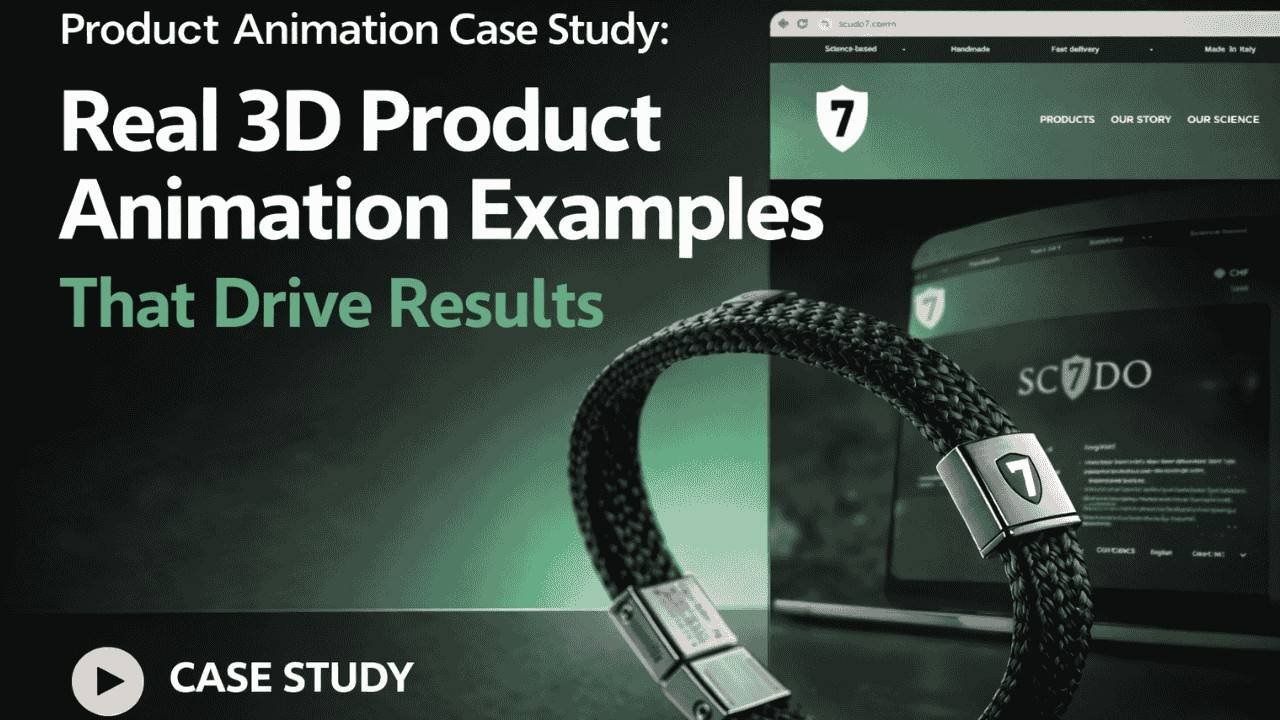
This article presents a real product animation case study — the Scudo7 wellness bracelet, handcrafted in Italy — to show how a professional animated product presentation transforms a complex value proposition into a clear, trustworthy visual story. Alongside it, you will find several 3D product animation examples across key industries, a full breakdown of the production process, the core marketing benefits, and expert answers to the most frequently asked questions businesses have before commissioning their first product animation video.
What Is Product Animation?
| Definition: Product animation is a 3D visualization technique used to showcase how a product works, its design features, and its material composition through motion graphics or computer-generated imagery. Unlike traditional photography, it can visualize internal mechanisms, molecular interactions, and assembly sequences that are physically impossible to film. |
The broader trend driving adoption of 3D product visualization is straightforward: buyers increasingly expect to understand a product before they buy it, not just see it. Professional studios build photorealistic digital models using industry-standard tools like Blender, Cinema 4D, and Autodesk Maya, then render them using high-performance engines such as V-Ray or Octane Render. The result — whether a 30-second product demo animation or a longer product explainer animation — communicates in seconds what a data sheet takes minutes to explain. It is used most strategically at product launches, on e-commerce landing pages, in investor presentations, and across paid social campaigns where clarity and stopping power are non-negotiable.
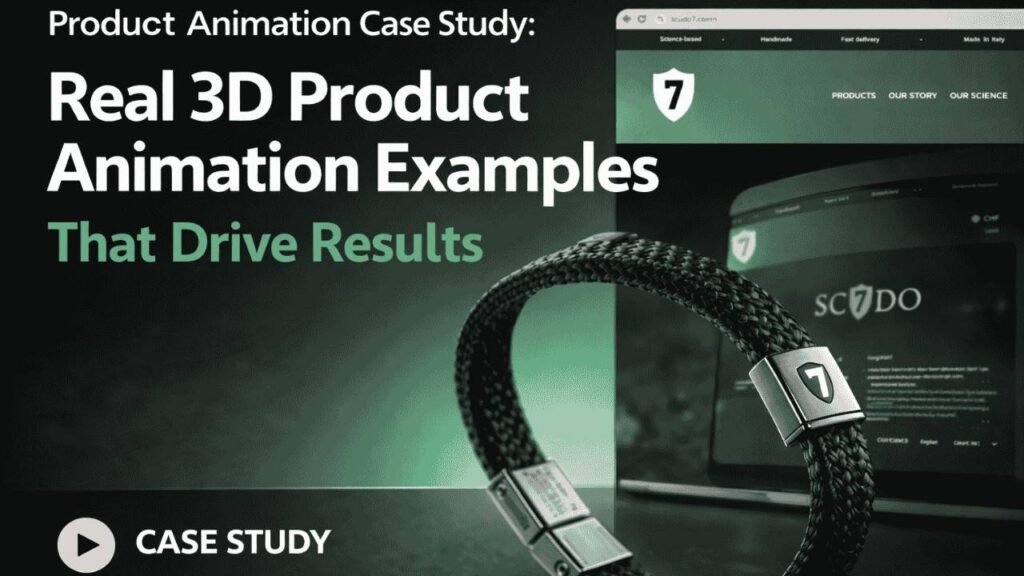
Product Animation Case Study: Scudo7 Wellness Bracelet
Client Overview
Scudo7 is an Italian wellness brand founded by inventor Fabrizio Serra. The name derives from the Italian word for ‘shield’ — a deliberate metaphor that reflects the bracelet’s promise of energetic protection and physical support for the wearer. Every Scudo7 bracelet is handcrafted in Italy using a science-based mineral composition developed over a decade of research, positioning the product at the intersection of artisan craftsmanship and human performance science. The target audience is a health-conscious European consumer who demands both aesthetic quality and evidence-based results from the wellness products they invest in.
The Challenge
Scudo7’s core marketing problem was a communication gap that no photograph or written description could close. The bracelet’s value proposition — that specific mineral materials interact with the human body’s energy field to deliver measurable health benefits — is a sophisticated scientific claim. Prospective buyers could see that the product was beautifully made, but they had no way to visualize or understand the mechanism behind the benefit. This created a persistent objection at the point of purchase that was costing the brand real conversions. Fabrizio Serra needed a format that could make the invisible visible and do so within the attention window of a modern digital consumer — ideally in under 35 seconds.
The Solution
Render Edge Studio produced a 32-second 3D product animation video using a combined Blender and Cinema 4D production pipeline, with Adobe After Effects handling the final compositing, motion graphic overlays, and color grading. The animation opened with a full product view of the bracelet, then progressively broke down its mineral layers through an exploded-view sequence, visualizing how each material component interacts with the body’s energy system through particle animation and anatomical overlays. The storyboard was structured so that every five-second segment answered one specific buyer question, building scientific credibility in a sequential narrative arc designed for digital distribution across web, Instagram, and paid media placements.
The Result
The final 3D animated product showcase resolved Scudo7’s most critical conversion barrier. By making the product’s scientific mechanism visible and comprehensible inside 30 seconds, the animated product presentation elevated the brand’s perceived credibility, reduced purchase hesitation, and gave the sales team a shareable visual asset that performed across every channel where it was deployed. The impact was direct: a complex, science-based value proposition became one of the brand’s most effective marketing tools — not despite its complexity, but because the animation embraced it.
3D Product Animation Examples Across Key Industries
The strategic application of product animation for marketing varies significantly by industry, and understanding those differences helps businesses identify the right creative approach for their product category. The following 3D product animation examples represent four of the most active sectors investing in this format today.
Example 1 — Industrial Product Animation
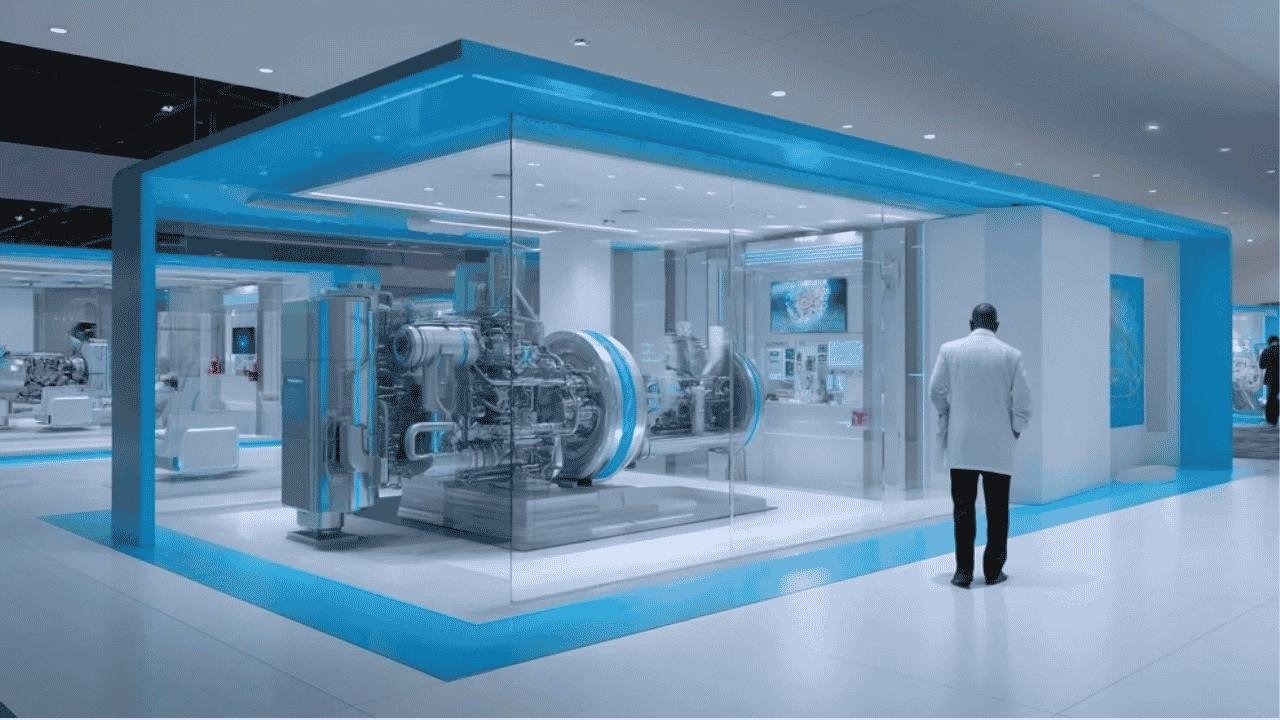
Industrial sectors are among the earliest and most consistent adopters of 3D product animation. Manufacturers of machinery, precision tools, and engineered components rely on animated product presentations to demonstrate assembly sequences, internal fluid dynamics, and performance specifications that physical photography cannot capture. A typical 3D product animation example in this space animates hydraulic or pneumatic systems through transparent housing, making invisible pressure dynamics instantly legible to both technical and commercial audiences. Studios use Autodesk Maya or Blender to build geometrically precise models from CAD data, rendered in V-Ray to achieve the photorealistic metal textures and environmental lighting that industrial clients require. The result is a product explainer animation that serves the marketing team and the field sales force simultaneously — a dual-purpose asset with significant commercial leverage.
Example 2 — Medical Device Animation
Medical product animation demands the highest standard of scientific accuracy while remaining visually accessible to mixed clinical and procurement audiences. A strong 3D product animation example in this category might visualize how a bioabsorbable implant integrates with bone tissue over six months — a biological process no camera can document. Studios producing medical animated product showcases rely on Cinema 4D’s advanced simulation tools for fluid and tissue interaction modeling, with high-quality product rendering ensuring the output meets both regulatory communication standards and the visual expectations of hospital decision-makers. The credibility impact of a well-executed medical product demo animation is substantial: it signals technical authority at the exact moment buyers are evaluating risk.
Example 3 — Consumer Product Animation
Consumer-facing 3D product animation balances scientific credibility with emotional resonance to drive purchase decisions at scale. A skincare brand launching a new active ingredient serum, for example, might commission a product explainer animation showing molecules penetrating the skin’s surface layers — making an invisible biological process the hero of the campaign. Adobe After Effects and Octane Render are the dominant tools in this category, enabling rapid iteration on brand-matched lighting, color grading, and motion graphic treatments that align the animation with a brand’s existing visual identity. The conversion impact of this format on e-commerce product pages is well-documented, with many retailers reporting significant uplift in add-to-cart rates after adding a 3D product visualization to their listing.
Example 4 — Technology Product Animation
Technology product animation has evolved from simple turntable renders into sophisticated, multi-layered visual storytelling. A 3D animated product showcase for a consumer electronics device might combine photorealistic exterior rendering with an animated cross-section revealing internal chip architecture, acoustic chambers, or thermal management systems — communicating engineering depth in a format that a spec sheet never could. Studios increasingly integrate Unreal Engine into their real-time preview pipeline, allowing clients to review and approve animation sequences far faster than traditional offline rendering workflows permit. NVIDIA’s GPU acceleration technology underpins the render performance that makes these tight production timelines commercially viable, enabling studios to deliver broadcast-quality CGI product animation on launch-day schedules.
The Product Animation Process: From Brief to Final Render
The growing demand for high-quality product rendering has pushed studios to formalize their production pipelines into repeatable, client-transparent workflows. Understanding this process helps brands plan budgets, set realistic timelines, and make better creative decisions at each stage. A professional 3D animation production pipeline follows five core stages, each of which builds directly on the last.
The process begins with concept development, where the studio and client align on the animation’s strategic objective, target audience, key visual messages, and reference aesthetics. This feeds into storyboarding, where a frame-by-frame sequence maps camera movements, animation beats, and on-screen text timing before any 3D modeling begins — making it the most cost-efficient point at which to make structural changes. The 3D modeling stage then constructs a photorealistic digital replica of the product using Blender, Cinema 4D, or Autodesk Maya, referencing physical samples or engineering drawings for dimensional precision. In the animation stage, the model is brought to life through choreographed camera work, object motion, particle effects, and lighting design. Finally, the rendering and compositing stage processes every frame through V-Ray or Octane Render and assembles the final deliverable in Adobe After Effects — adding motion graphics, brand treatments, and sound design to complete the product animation workflow.
Why Product Animation for Marketing Delivers Real Business Results
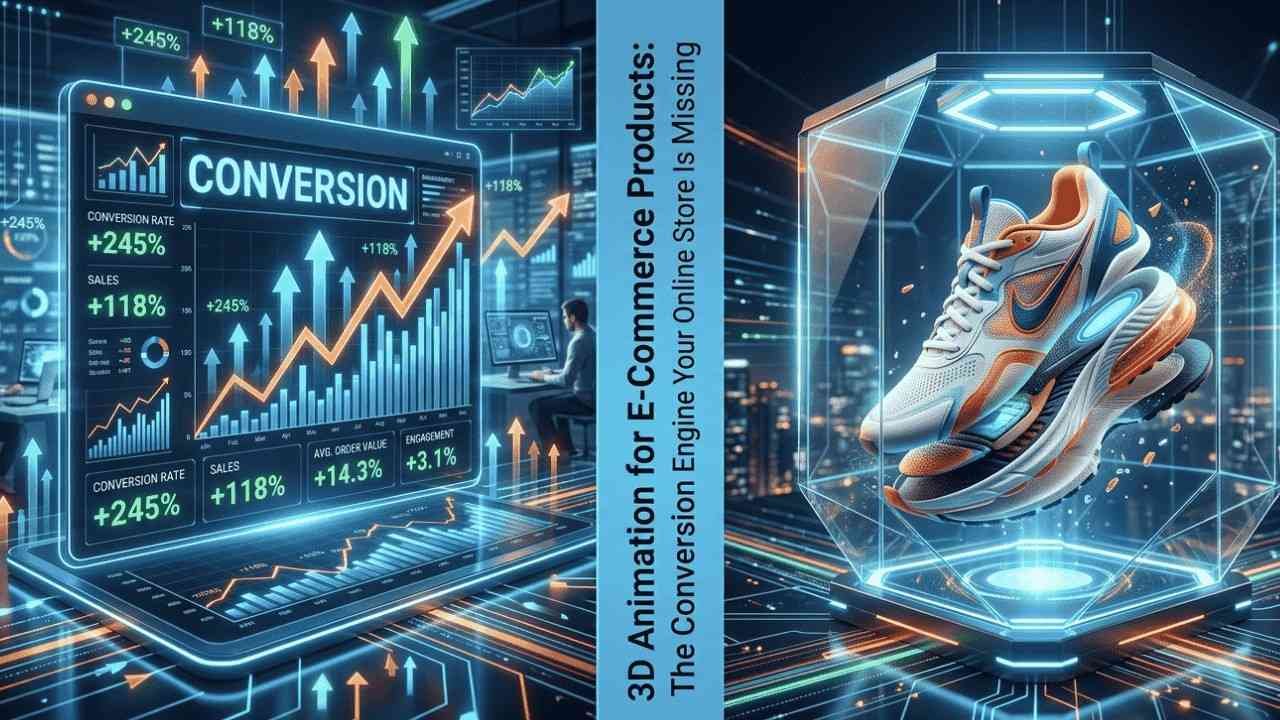
The commercial case for investing in 3D product animation is no longer theoretical — it is measurable. The most immediate benefit is the ability to explain products that words and photographs cannot adequately describe. For any brand whose core value proposition involves an invisible mechanism, a molecular interaction, or a process that unfolds over time, a product explainer animation eliminates the buyer’s most persistent objection before it is ever voiced. Beyond explanation, a professionally produced 3D animated product showcase delivers consistent, controllable visual quality that no physical shoot can replicate — with no sample logistics, no location constraints, and no post-production retouching costs.
From a performance standpoint, product pages featuring video content consistently outperform image-only pages on both conversion rate and average session duration. More strategically, a single high-quality product animation video functions as a long-term, multi-channel asset — equally deployable in paid media, organic social, investor decks, trade show displays, and email campaigns — delivering compounding return on investment across its entire active life. In a competitive landscape where buyers expect to understand before they buy, 3D animation for product marketing is no longer a differentiator. It is becoming a baseline expectation.
Frequently Asked Questions
What is product animation used for?
How much does 3D product animation cost?
How long does a product animation video take to produce?
Why do companies use 3D product animation instead of traditional video?
Start Your Product Animation Project From Here
If your product’s value is difficult to communicate through images or copy alone, professional 3D product animation may be the most strategic visual investment you can make this year. At Render Edge Studio, we specialize in transforming complex product ideas into clear, high-quality visual stories — from initial concept through to final render. Whether you are preparing for a product launch or building out your long-term content strategy, we would be glad to help. Visit our product animation services page to explore our full portfolio.