In today’s crowded trade show halls, standing out is a challenge. Flashy lights and shouting crowds mean most booths blend together – unless you grab attention instantly. That’s where 3D animation and explainer videos shine. A dynamic looping video or interactive 3D demo can cut through the noise, stop foot traffic, and turn casual visitors into leads. Experts agree: trade shows are perfect for “visual storytelling” – using motion and graphics to “catch people’s attention and encourage them to stop and explore your booth”.
Imagine walking by a sea of static banners versus a towering screen playing a cinematic product reveal. That’s the difference: motion draws the eye. Companies like Showfloor Visuals note that high-quality 3D content is not just decoration, it “creates instant understanding – the key to sparking serious sales conversations.” In fact, interactive videos can hold visitors 4.5× longer and boost conversions by ~37%. In short, the right 3D animation or explainer video can turn a “hard pass” into a serious sales opportunity.
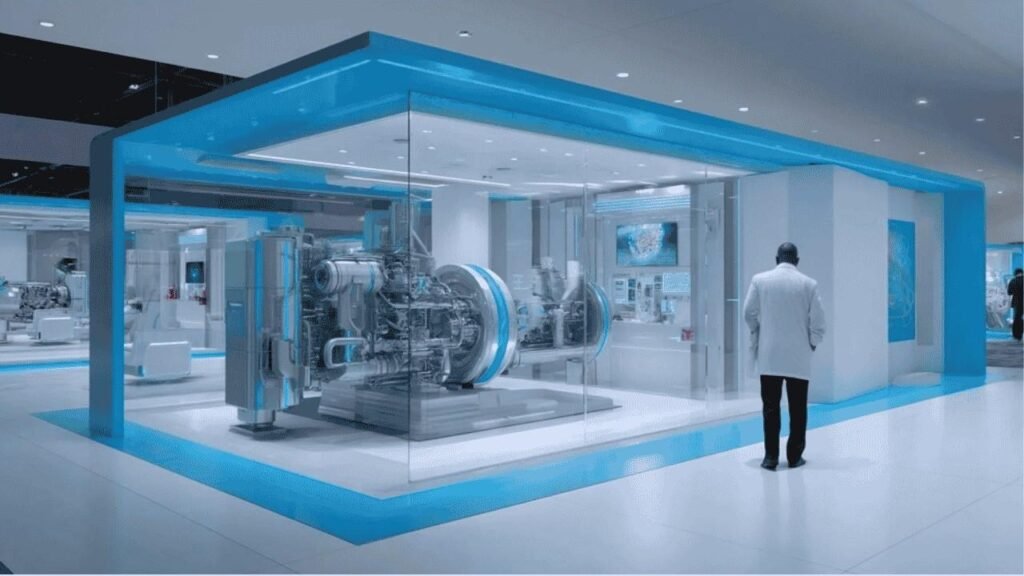
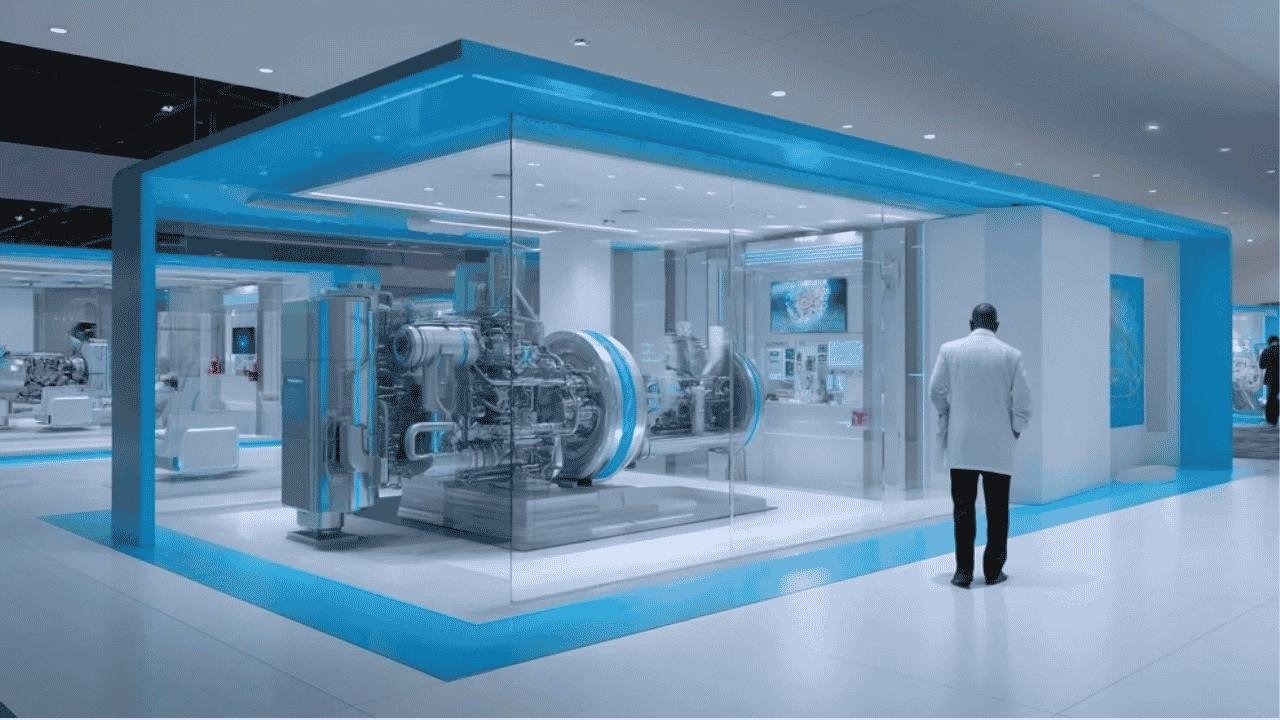
Figure: A futuristic trade show booth demo. Immersive 3D visualizations (like this machinery cutaway) draw attendees in faster than static displays. High-impact graphics and live demos create a memorable experience.
Why 3D Animations Matter at Trade Shows
Trade show attendees have seconds to notice your message. A study in med tech expos found that without instant clarity, booth visitors simply move on. 3D animations solve this “attention gap” by telling a story in seconds. Instead of a salesperson explaining a complex device, an animated cutaway on screen “showcases inner workings in photorealistic detail”. It’s like handing them an X-ray of your product on the spot.
Consider this: a medical device with dozens of components is confusing to describe. A short 3D reel can turn it into a “clear, captivating story”. Showfloor Visuals reports that when busy visitors see engaging visuals, they stay 4.5× longer at the booth. That extra attention is the key to turning eyeballs into conversations (and eventually sales). In fact, animated storytelling at events can “create instant understanding — the key to sparking serious sales conversations.”
Benefits of 3D Booth Animation:
- Stop the Scroll: In a hallway filled with blinking screens, the most dynamic content wins. 3D moving visuals act like a beacon, pulling in curious attendees immediately.
- Explain Complex Products: Think of 3D animation as a mini-demo on loop. It can highlight inner workings and exploded views that physical demos can’t show. Imagine showing an engine’s innards or a device’s circuitry in seconds – impossible with brochures.
- Emotional Impact: Motion graphics and storytelling make the experience memorable. As Breeze Animation notes, trade shows are the time to present your brand “in a clear and memorable way”, and nothing is more memorable than a vivid, moving scene.
Ultimately, 3D booth animations act like a magnet. They’re not just pretty; they deliver information faster and more engagingly than text or speech. Visitors get it immediately, reducing questions and pushing them further down the sales funnel.
Explainer Videos: Converting Visitors into Leads
While animations engage, explainer videos take it a step further toward conversion. An explainer video is a short, narrative-driven clip that highlights key benefits or features of your product. Think of it as a trailer for your tech. These videos can be 3D, 2D, or hybrid, but at trade shows 3D explainers have special power because of their “realistic depth and detail”.
A high-quality 3D explainer does more than wow the crowd; it delivers a pitch on autoplay. According to Digital Brew, “3D explainer videos offer a visually striking way to communicate complex ideas with clarity and impact.”. In practice, that means a looping animation on a screen can “educate the audience” about your product while your sales team talks to someone else. It’s like having an extra salesperson – 24/7.
Key uses of 3D Explainer Videos at Shows:
- Product Demos: Show how your product works in action. For example, an LED video wall can play a 3D demo of a machine assembling parts or a mobile app interface animating through screens. Attendees get the idea instantly.
- Brand Storytelling: Use engaging characters or scenarios. A quick story (“Imagine a world where…”) can hook people emotionally, even in a busy booth.
- Process Walkthroughs: Explain a complex process step-by-step. 3D visuals can slice, zoom, and annotate, making dense information light and easy.
Interactive kiosks also amplify explainers. For instance, Autodesk’s IMTS 2022 booths featured six interactive video kiosks. Visitors touched screens to see Fusion360’s parts in 3D and even played with models themselves. Meanwhile, an 80-inch LED continuously looped high-res animations of their software’s tools, ensuring no one missed the message. This mix of self-service video and large-screen spectacle is a proven way to generate leads: attendees are naturally curious about cutting-edge demos and more likely to request follow-ups.
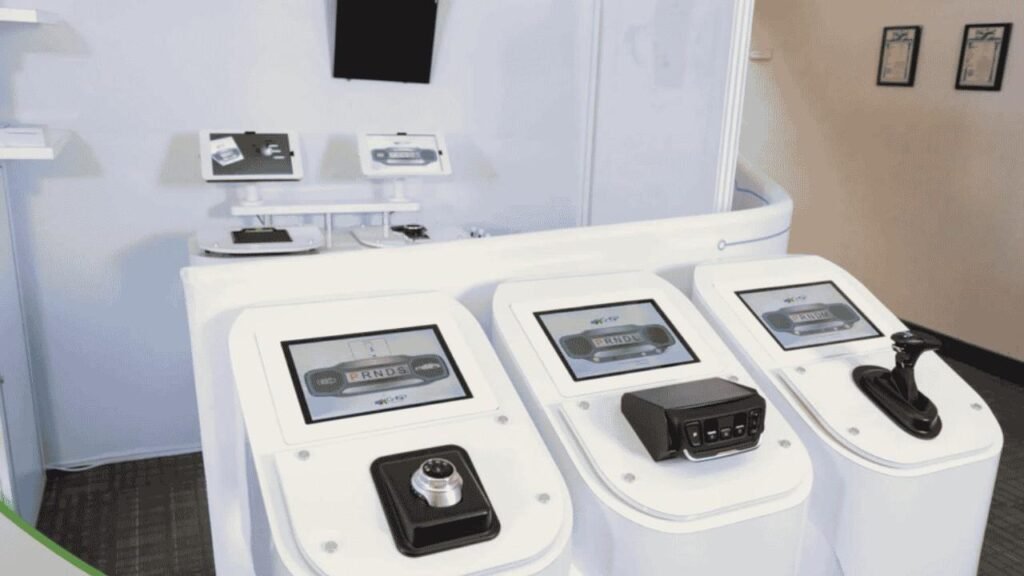
Figure: An example interactive booth setup. Visitors engage with touch-screens showing 3D product demos. Interactive kiosk displays and looping explainer videos (as shown here) convert passive viewers into active prospects.
Core Technologies: Software & Production
Behind every seamless trade show animation is a stack of powerful software. Many studios combine tools for modeling, animation, and final compositing. Here’s a quick rundown:
- Cinema 4D & Autodesk Maya (3D Modeling/Animation): These industry staples let creators build and animate every part of your product or environment. As one studio notes, “Cinema 4D paired with Redshift is a powerhouse combo for producing stunning 3D visuals.”. Maya is similarly used for ultra-detailed engineering simulations.
- Blender (Open-Source 3D): A free yet capable alternative, Blender supports full 3D pipelines (modeling, rigging, texturing, rendering). It’s gaining traction for trade show content due to its flexibility and no licensing cost.
- Adobe After Effects (Compositing/VFX): After Effects is often the final step, where animations are polished. Showfloor Visuals confirms After Effects is “the go-to for seamless animation, compositing, and visual effects.”. It’s used to add motion graphics overlays, match live footage to 3D renders, and fine-tune colors.
- Redshift/Octane/Arnold (Render Engines): These GPU/CPU renderers crank out photo-realistic frames. Redshift in Cinema 4D (as mentioned above) slashes render times with GPU power, making it feasible to produce high-quality content on tight deadlines.
- Emerging Tools (AI/Real-Time): Newer technologies like AI-driven upscaling (Topaz, Waifu, etc.) and real-time engines (Unreal Engine, Unity) are speeding up production. They let studios iterate faster and even render some scenes on-the-fly.
These tools work behind the scenes, but for clients, the takeaway is simple: a professional service will have the right expertise to deliver polished videos. Studios might show you a pre-production storyboard or a quick 3D mockup of your product early on – a kind of digital prototype of your marketing message. This is like creating a virtual rehearsal for your trade show demo before the hardware even arrives.
Case Examples: Big Shows and Booth Wins
Trade shows around the globe are already embracing 3D visuals. At CES (consumer electronics in Las Vegas), many tech giants feature large video walls with 3D visualizations of products. For example, Caterpillar’s 2026 booth included a bespoke cinematic sequence blending live demos and 3D animation. It’s no surprise: CES attendees expect cutting-edge displays. Similarly, at InfoComm (AV industry’s flagship show), presenters often demo 3D virtual walkthroughs of systems on giant screens and VR headsets – think immersive product tours.
The manufacturing world’s top show, IMTS in Chicago, is another hotspot. We saw Autodesk’s booth use multiple 3D elements – from interactive kiosks to giant LED loops – to highlight their CAD/CAM tools. Even without a citation, it’s known that heavy machinery and industrial companies turn to 3D because they can’t lug around actual equipment. Hannover Messe in Germany (industrial tech) and Electronica in Munich (electronics) are similar: 3D models let exhibitors ‘teleport’ factory lines and microchips to the booth. And events like SIGGRAPH (graphics/animation conference) are the cutting edge, where you’ll often see prototype AR/VR demos that blend physical exhibits with 3D overlays.
These examples show a pattern: wherever the audience is technical or visual, 3D explainer content is a hit. It gives complex products instant appeal. In fact, Showfloor reports that companies who use this strategy “showcase their value clearly — especially in high-traffic environments like trade shows.”.
Cost, ROI and Budgeting
You might wonder: how much do these animations cost, and are they worth it? It’s true 3D content isn’t free. Pricing depends on complexity, length, and detail. To give ballpark figures: simple 2D/3D loops or teaser clips can start in the low thousands of dollars. A polished 30–60 second 3D product demo often runs from $5K up to $15K. Highly detailed technical animations (with full CAD data, intricate lighting, or interactive features) can range from $20K–$50K or more.
For perspective, Industrial3D (a Dallas studio) notes that basic explainer animations might cost $2K–$10K, while specialized industrial simulations can reach $10K–$50K. Of course, prices vary by provider and location. New trends (real-time engines, AI tools, reusable assets) are gradually lowering costs, but top-tier work still requires skilled artists and time.
Is it worth the spend? Think of these videos as high-leverage marketing. A single well-made animation can be repurposed beyond the booth – on your website, in sales pitches, or on social media. Showfloor Visuals observed that clients who use animated content report up to 37% higher lead conversion. Plus, videos never sleep: they work round-the-clock at your booth explaining your pitch.
To maximize ROI, define clear goals. Maybe start with one “hero” video or loop for your booth, then scale up. Even a quick 5-second teaser loop can stop passersby (Showfloor recommends a 5-second preview to grab attention). After the show, reuse the full version in email campaigns or web demos. Think of the video cost as buying exposure for thousands of viewers, not just one-time display.
In short, budget wisely: prioritize a standout demo or product animation first. Then expand to process explainers or interactive content. Even a mid-level investment in 3D animation tends to pay off in higher engagement. As Showfloor sums up: “Trade shows aren’t just about getting noticed. They’re about converting attention into revenue.” Good 3D animation bridges that gap.
Final Thoughts
Investing in trade show 3D animation services and explainer videos is no longer a novelty – it’s a competitive necessity. When booths vie for attention, animated visuals give you the upper hand. From capturing the wandering eye to conveying complex ideas instantly, high-quality 3D content is like a silent salesperson working every second. Remember: an effective trade show presence is about engaging people and sparking conversations. The right animation can do both.
By using dynamic 3D demos, explainer loops, and interactive booths, you make your product understandable and memorable. As experts note, animations turn a crowded booth into a sales generator. Whether you’re at CES or Hannover Messe, a good 3D video is a crowd magnet. So start planning your visual story today – with every new animation, your booth’s impact multiplies.
Another Reads:
3D Explainer Videos for SaaS: Benefits, Examples & ROI
3D Animation for E-commerce Products to Boost Sales
3D Architectural Animation: Cost, Process, Benefits, Trends & Complete Guide
Frequently Asked Questions (FAQ)
Q1: What exactly is a trade show explainer video?
A: It’s a short animated video (often 3D) that explains your product or service. It can be on loop at your booth, highlighting features and benefits. Think of it as a mini-presentation on screen. A great explainer uses clear visuals and narration to tell a story in under a minute, so visitors immediately get what you offer.
Q2: How does 3D animation improve booth engagement?
A: 3D animation uses motion and depth to catch the eye. While static posters are easy to ignore, moving visuals draw people in. Animations can show things that a live demo can’t (like the inside of a device or a fast process). This not only grabs attention but also explains complex ideas quickly, holding visitors’ interest longer.
Q3: Which industries benefit most from trade show 3D animations?
A: Technical and complex industries love 3D demos. Medical devices, engineering, industrial machinery, SaaS/tech products, even automotive – all use 3D to simplify their message. Anywhere a product has unseen moving parts or complicated features, a 3D animation helps clarify the story for buyers.
Q4: How long does it take to create a 3D booth animation?
A: Typical timelines are several weeks to a few months, depending on length and detail. A short teaser (10–15 seconds) might take 2–4 weeks. A full 60-second product animation could be 6–8 weeks of production. This includes scripting, storyboarding, modeling, animating, and revisions. It’s best to plan ahead to align with your show date.
Q5: What’s the difference between a 2D and a 3D explainer video?
A: A 2D explainer is flat, often cartoon-style, and works well for simple concepts or budget-conscious projects. A 3D explainer adds depth and realism – you can rotate objects, use camera moves, and create life-like scenes. For trade shows, 3D tends to stand out more and can handle technical content in a visually impressive way.
Q6: How do I measure the ROI of a trade show animation?
A: Look at leads and engagement during the event. Metrics can include booth traffic, demo requests, or follow-up calls. You can track conversions by asking visitors if they saw the video or using QR codes in the animation that lead to landing pages. Many clients report higher engagement (up to 4–5× longer interactions) and better lead quality when using compelling 3D content.