Imagine this: You’re browsing an online furniture store. One item has a flat, basic photo. The next item? A beautiful 3D animation that allows you to rotate the sofa, zoom in on the fabric, and see it from all angles. Which one do you click “add to cart”? If you picked the second, you’re not alone. The furniture is experiencing a new visual revolution, with 3D animations that bring product imaging to life over traditional 2D images. But that’s the million dollar question. Do you stick with the tried and true? Or do you fully embrace 3D animations in your furniture marketing? Let’s talk about it!
What Is the Difference Between 2D Animation and 3D Animation?
Think of 2D images as looking at a postcard. It’s flat, straightforward, and shows you one perspective.
Now imagine 3D animations as holding the actual object in your hands. You can rotate it, examine it from different angles, and truly understand what you’re looking at.
Here’s the simple breakdown:
2D Images:
- Flat photographs or illustrations
- Single viewpoint
- Quick to produce
- Lower production cost
- Limited interaction
3D Animations:
- Dynamic, interactive visuals
- Multiple viewing angles
- Photorealistic rendering
- Higher initial investment
- Immersive customer experience
The difference isn’t just technical. It’s about how your customers feel when they interact with your products online.
Why 2D Images Still Matter in Furniture Marketing
Before we crown 3D animations as the undisputed champion, let’s give 2D images their fair share of credit.
Speed and Simplicity
Need to promote something quickly? 2D product photography can get you there quickly – a pro photographer can shoot an entire furniture line in one day.
No expensive or complex 3D rendering software; no weeks of building a model and adding textures; Just point, shoot and edit.
Budget-Friendly for Startups
If you’re a small furniture business starting off, 2D images make financial sense. There’s no need to invest in expensive furniture design software or hire specialized 3D artists.
You can usually get away with a good camera and light.
Perfect for Technical Specifications
When companies need building plans or assembly instructions, 2D technical drawings are extremely straightforward. Carpenters and factory workers recognize them immediately.
You could think of them as the common language spoken in the production of furniture.
Easy Updates and Modifications
Altered a color of a fabric? All you need to do with your 2D images, is just take another photograph of that specific angle. It’s easy and doesn’t require skill.
But here’s where 2D images fall short:
They’re unable to illustrate how a recliner reclines. They are unable to show how smoothly cabinet drawers slide. They can’t invite customers to imagine furniture within their space.
And in a world full of digital advertising campaigns, this is a significant limitation.
The Game-Changing Power of 3D Animations in Furniture Marketing
Now, let’s talk about why 3D animations are revolutionizing visual marketing strategies for furniture brands.
Product Animation Increases Sales (Here’s How)
Studies show that product pages with 3D visualization see conversion rates jump by up to 40%. Why?
Because 3D animations answer the questions customers have before they even ask them.
Real-Life Example:
IKEA added 3D product visualization to their app. Customers can now utilize augmented reality to place virtual furniture in their real-life rooms. The end result? Much lower return rates and greater customer confidence. Here is a guide on how product animation increases sales.
That’s the value of letting people “try before they buy.”
Benefits of 3D Product Visualization
Let me paint you a picture of 3D product visualization benefits:
1. Show Functionality in Action
- Watch a sofa bed transform from seating to sleeping
- See drawers sliding open smoothly
- Demonstrate adjustable height mechanisms
- Display hidden storage compartments
2. Create Emotional Connections 3D animations don’t merely display products; they tell stories. Add ambient lighting, furnish a space with beautiful furniture, and all of the sudden you’re not selling a chair, you’re selling a lifestyle.
3. Unlimited Customization: Would you like to see the same dining table in 12 different wood finishes? By using 3D rendering, you model once, and change any materials or colors with a few clicks.
No need for multiple photo shoots. No storage issues with different samples.
4. Perfect for Amazon 3D Render Requirements: Amazon now prioritizes listings with 3D renders and 360-degree views. If you’re selling furniture on major e-commerce platforms, 3D visualization isn’t optional anymore—it’s expected. Here is our detailed guide on Benefits of 3D Rendering for Amazon Sellers.
How 3D Animation Boosts Furniture Sales
Here’s where things get really interesting.
Interactive Product Configurators
Imagine customers building their perfect sectional sofa online. They choose:
- The configuration (L-shape, U-shape, straight)
- Fabric type and color
- Leg style
- Cushion firmness
All visualized in real-time 3D. This level of personalization drives serious purchasing decisions.
Virtual Showrooms
Furniture animation service providers are now developing entire virtual showrooms. Consumers can now move through a space in a digital capacity and examine products from every angle without leaving the comforts of their couch.
During the pandemic, brands that had invested in 3D visualization were able to sustain sales, while companies who only had static images struggled. If you are interested here is a guide on Ways 3D Furniture Animation Boosts Online Sales.
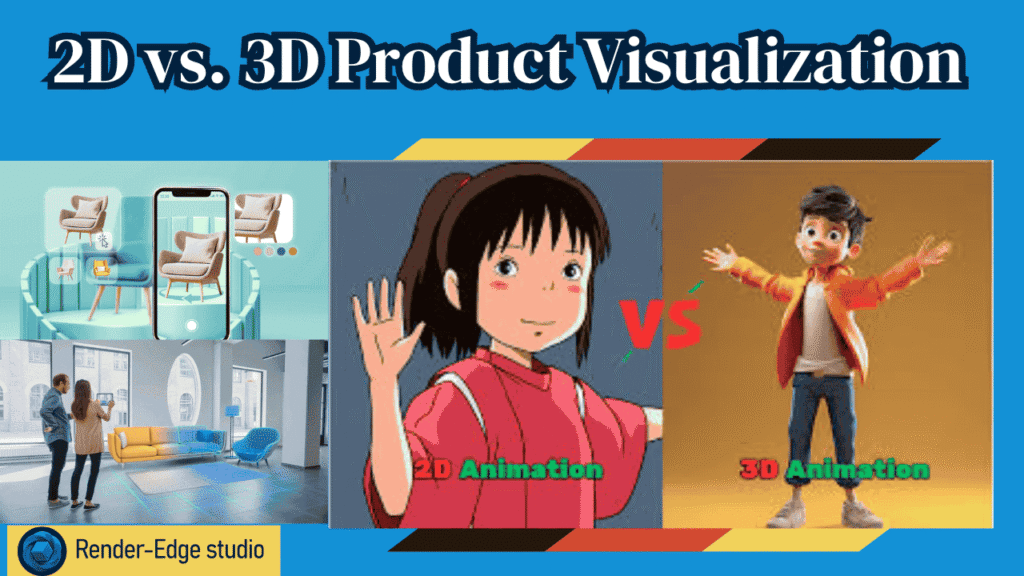
2D vs. 3D Product Visualization: The Head-to-Head Comparison
Let’s put them side by side so you can make an informed decision.
| Feature | 2D Images | 3D Animations |
| Production Speed | Fast (days) | Slower (weeks) |
| Initial Cost | Low ($500-$2,000) | Higher ($2,000-$10,000+) |
| Viewing Angles | Limited to what’s photographed | Unlimited 360° rotation |
| Customization | Requires reshoots | Instant digital changes |
| Customer Engagement | Moderate | High (interactive) |
| Return Rates | Higher (expectation mismatch) | Lower (accurate visualization) |
| Mobile Experience | Static viewing | Interactive exploration |
| AR/VR Integration | Not possible | Seamlessly compatible |
| Long-Term Cost | Ongoing photo shoots | One-time investment, reusable |
| SEO Value | Standard image optimization | Rich media boosts rankings |
When Should You Choose 2D Images?
2D images still make sense in specific situations:
- Budget constraints are severe If you’re bootstrapping a furniture startup, start with quality 2D photography. You can always upgrade later.
- Quick product launches Need to get seasonal items online immediately? 2D images get you to market faster.
- Technical documentation Assembly instructions, manufacturer specifications, and construction details work better as clear 2D diagrams.
- Print advertising For magazine ads or catalogs where interactive elements aren’t possible, professional 2D photography still shines.
When Should You Choose 3D Animations?
3D animations are your best bet when:
- Selling complex furniture pieces Modular systems, transformable furniture, or items with multiple configurations need 3D visualization.
- Targeting high-end markets Luxury furniture brands need that premium, immersive experience. 3D animations signal quality and innovation.
- Building a long-term digital presence If you’re investing in interior design marketing for the long haul, 3D models become reusable assets across all platforms.
- Competing on major e-commerce platforms Amazon, Wayfair, and other platforms reward listings with rich 3D content through better search placement.
- Reducing returns and customer service issues When customers can examine products thoroughly before purchase, they make better decisions.
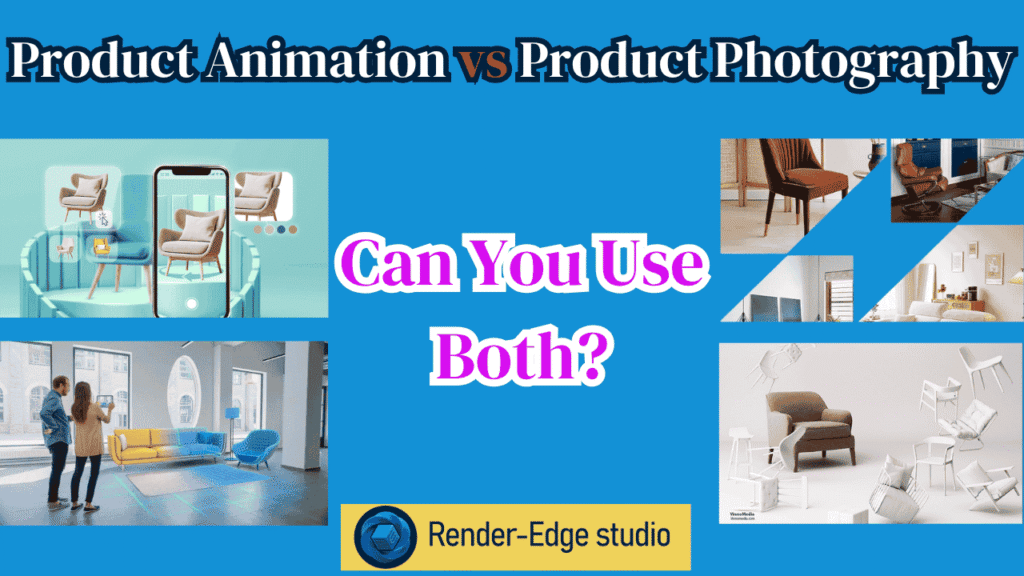
Product Animation vs Product Photography: Can You Use Both?
Here’s a secret the best furniture brands know: You don’t have to choose just one.
The Hybrid Approach:
Start with 3D rendering for your core collection. Use it to create:
- Interactive 360° product views
- Customization configurators
- AR try-before-you-buy features
Then supplement with lifestyle 2D photography showing:
- Real room settings
- Styled scenarios
- Human interaction with furniture
This combination gives you the technical accuracy of 3D with the emotional warmth of real photography. You can also check out this guide on 3D Product Animation vs Product Photography.
How to Get Started with 3D Furniture Visualization
Ready to make the leap? Here’s your step-by-step roadmap:
Step 1: Choose Your Furniture Designing Software
Popular options include:
- Blender (free, powerful, steep learning curve)
- SketchUp (beginner-friendly, good for simple models)
- 3ds Max (industry standard, professional-grade)
- KeyShot (excellent for photorealistic rendering)
Step 2: Decide: In-House or Outsource?
Building an in-house 3D team requires significant investment in software licenses, training, and hardware.
Many furniture brands find better ROI working with specialized furniture animation services initially.
Step 3: Start with Your Best-Sellers
Don’t try to convert your entire catalog overnight. Pick your top 5-10 products and create 3D models of those first.
Step 4: Test and Measure
Implement A/B testing. Compare conversion rates between product pages with 2D images versus those with 3D animations.
Track metrics like:
- Time spent on page
- Add-to-cart rates
- Return rates
- Customer satisfaction scores
Step 5: Scale Based on Results
Once you prove the ROI, gradually expand your 3D visualization library.
Benefits of 3D Rendering Over Traditional Photography
Let’s talk about the long-term advantages that make 3D rendering a smart investment.
Consistency Across All Materials
Have you ever attempted to photograph dark wood and light fabric in the same image? If you light one correctly the other looks wrong. 3D rendering allows you to perfectly balance the lighting for all materials simultaneously.
No Physical Samples Needed
Evaluate new designs with online test marketing before the actual manufacturing. Get customer feedback on styles and colors before actually producing them.
This will lessen the inventory risk and shorten development cycles.
Instant Global Marketing
Create your 3D model once. Then use it across:
- Your website
- Social media campaigns
- Email marketing
- Print catalogs
- Virtual showrooms
- AR applications
- Trade show presentations
Future-Proof Your Visual Assets
That 3D model you create today? It’ll work with whatever technology emerges tomorrow—whether that’s VR shopping experiences or holographic displays.

Real Success Stories: Brands Winning with 3D Visualization
Wayfair’s AR Success
Wayfair has a feature called ‘View in Room 3D’ that allows customers to virtually position furniture inside their homes. Wayfair says that customers who use this feature are more likely to purchase the item and less likely to return it.
West Elm’s Virtual Design Services
West Elm offers a 3D room visualizer as well as the option for consultations with designers. Their customers are able to see their entire room designed in 3D before they buy anything.
The outcome? Customers make larger average order sizes, and are happier.
IKEA’s Place App
IKEA’s augmented reality app leverages 3D product visualizations to allow customers to place life-sized models of furniture right in their space via their smartphone cameras.
Customers have shown they want this interactive experience, demonstrated by durable customer demand of this technology with over 2 million downloads.
Common Mistakes to Avoid
Mistake 1: Prioritizing Pretty Over Accurate
Your 3D animations must accurately represent the actual product. Overselling through unrealistic renders leads to disappointed customers and returns.
Mistake 2: Ignoring Mobile Optimization
Over 70% of furniture shopping starts on mobile devices. Your 3D visualizations must load quickly and work smoothly on smartphones.
Mistake 3: Forgetting About SEO
3D animations and videos need proper optimization:
- Descriptive file names
- Alt text for accessibility
- Schema markup for rich snippets
- Fast loading speeds
Mistake 4: No Clear Call-to-Action
Amazing visuals mean nothing if customers don’t know what to do next. Every product page needs clear next steps.
The Future of Visual Content Creation in Furniture
Where is this all heading?
AI-Powered 3D Generation
With the emergence of artificial intelligence, 3D model creation is becoming speedier and more conven/options. It’s not too far away that generating photorealistic furniture 3D renders will be (as simple as) telling the machine what to render in text.
Virtual Reality Showrooms
Virtual reality headsets are starting to become mainstream technology for home use; just imagine letting customers walk through your entire furniture collection while seated in their living room.
Hyper-Personalization
With advanced product configurators, customers will be able to design fully custom furniture pieces which will permit them to view every change in real-time 3D. Brands that are investing in 3D visualizations today will be on the technical forefront of the furniture industry of tomorrow.
Frequently Asked Questions
Q: How much does 3D furniture visualization cost?
Basic three-dimensional models begin anywhere from $500 to $1,000 a piece. For complex, highly detailed animations, you can expect to pay somewhere in the $5,000 to $10,000 range, if not more. However, these are expenses that pay off with lots of long-term value.
Q: Can I create 3D animations without technical skills?
Simple packages like SketchUp, or 3D features on sites like Canva offer beginners the ability to create basic 3D visualization. Consider working with a professional service specializing in furniture animation if you are seeking a professional result.
Q: Do 3D animations really increase sales?
Yes. Studies consistently show that interactive 3D product visualization increases conversion rates by 20-40% and reduces return rates by improving purchase confidence.
Q: How long does it take to create a 3D furniture model?
Simple models take 1-2 weeks. Complex pieces with intricate details might require 3-4 weeks. Once created, though, modifications are quick and easy.
Q: Are 2D images becoming obsolete?
Not entirely. They still serve specific purposes in print and quick campaigns. However, 3D visualization is increasingly becoming the standard for online furniture marketing.
Final Thoughts
So, comparing 2D images vs 3D animations for furniture marketing—which wins?
The honest answer? It depends on your specific situation.
Choose 2D images if:
- You need immediate results on a tight budget
- You’re selling simple, straightforward furniture
- You’re primarily focused on print advertising
Choose 3D animations if:
- You want to reduce returns and increase conversion rates
- You’re selling on major e-commerce platforms
- You’re building a premium, modern furniture brand
- You want reusable visual assets across multiple channels
Go hybrid if:
- You want the best of both worlds
- You have the budget for strategic investment
- You’re serious about long-term growth
The only question left is: Will you lead the change, or watch competitors pass you by?
The furniture industry is evolving rapidly. Visual marketing strategies that worked five years ago are barely adequate today.
Customers expect immersive, interactive experiences. They want to explore products from every angle, customize options in real-time, and visualize furniture in their own spaces before buying.
3D product visualization in furniture advertising isn’t just a trend—it’s becoming the new standard.