E-commerce has never been more competitive — or more visual. With over 26 million online stores operating globally and platforms like Shopify, Amazon, and WooCommerce hosting millions of active sellers, the margin between a conversion and an abandoned cart has never been thinner. Against this backdrop, the limitations of traditional static product photography have become impossible to ignore.
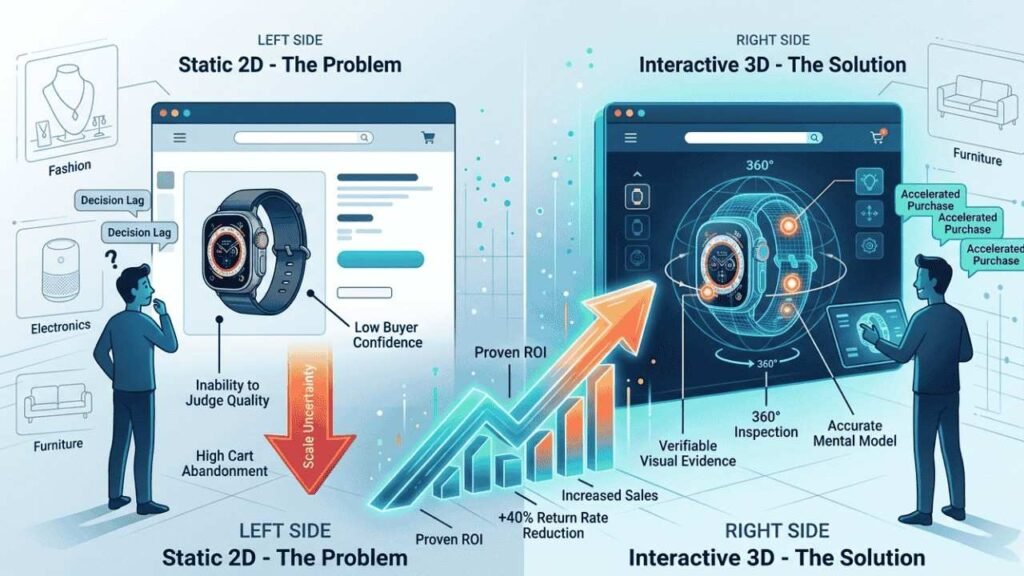
Research consistently shows that shoppers make purchasing decisions in seconds, and the inability to physically interact with a product is the single greatest barrier to online conversion. A flat, two-dimensional image simply cannot communicate texture, scale, depth, or functionality — the very attributes that drive purchase confidence. The result? High bounce rates, low add-to-cart percentages, and an industry-wide product return rate that costs retailers an estimated $816 billion annually in the United States alone (NRF, 2022).
3D animation for e-commerce products directly addresses this gap. By replacing static imagery with immersive, interactive, and motion-driven product presentations, forward-thinking brands are achieving measurable improvements in engagement, conversion, and post-purchase satisfaction. This guide explores what 3D product animation is, why it has become operationally essential for online retailers, and how to strategically deploy it across your e-commerce ecosystem.
What Is 3D Animation for E-Commerce Products?
At its core, 3D product animation is the process of creating photorealistic, computer-generated visuals that simulate a physical product in three-dimensional space — and then animating that model to move, rotate, disassemble, or interact with a digital environment. Unlike traditional photography, which captures a product from a fixed angle under specific lighting conditions, 3D animation is entirely constructed in software, giving studios and brands unprecedented control over every visual variable.
The practical applications within e-commerce are broad. A 360-degree product visualization allows shoppers to orbit a product from every angle, replicating the tactile exploratory behavior of in-store browsing. An AR product demo lets customers project a photorealistic 3D model of a sofa or smart device into their own living space via smartphone. A digital product presentation can integrate seamlessly into a Shopify product page, an Amazon listing, or a WooCommerce store, functioning simultaneously as a conversion tool, a trust signal, and a marketing asset.
What distinguishes conversion-focused product animation from purely aesthetic animation is intent. Every frame, transition, and interaction is engineered to reduce purchase hesitation, answer visual questions before they arise, and move the shopper closer to the checkout.
Why 3D Animation Is Essential for Online Sales
The case for 3D animation in e-commerce is no longer theoretical — it is supported by a growing body of behavioral research and industry performance data.
Accelerating Purchase Decisions
Consumer psychology research from the Baymard Institute identifies “inability to judge product quality” as one of the top reasons for cart abandonment. When a shopper can rotate a product, zoom into surface details, or watch a mechanism in motion, the cognitive effort required to evaluate a purchase drops significantly. Studies by Marxent (now part of PTC) found that AR-enabled product previews can reduce product return rates by up to 40%, precisely because shoppers arrive at purchase with a more accurate mental model of what they are buying.
Building Brand Trust Through Interactivity
Trust is the currency of e-commerce. Improve customer trust with interactive animation by giving shoppers verifiable visual evidence of product quality. A rotatable 3D model of a Swiss-movement watch communicates craftsmanship in a way that a flat JPEG cannot. An interactive product demo for a smart home device that highlights features in sequence answers technical questions without requiring a support chat. These interactions build confidence — and confident shoppers convert.
Industry Applications With Proven ROI
The impact of 3D animation varies by vertical, but the pattern is consistent:
- Fashion e-commerce (jewelry, watches, accessories): 360° rotatable models allow shoppers to inspect clasp mechanisms, stone settings, and surface finishes — details that drive premium purchases.
- Electronics e-commerce (gadgets, smart devices): Assembly and functionality animations demonstrate product integration, button placement, and port configurations — reducing pre-sale support queries.
- Furniture e-commerce (sofas, chairs, tables): Lifestyle 3D animations place furniture in realistic room environments, addressing the single greatest barrier in the category: scale uncertainty.
Across all three categories, platforms like Shopify, Amazon, and WooCommerce have progressively expanded support for 3D and AR content, reflecting the measurable commercial impact these formats deliver.
Types of 3D Animation for E-Commerce Products
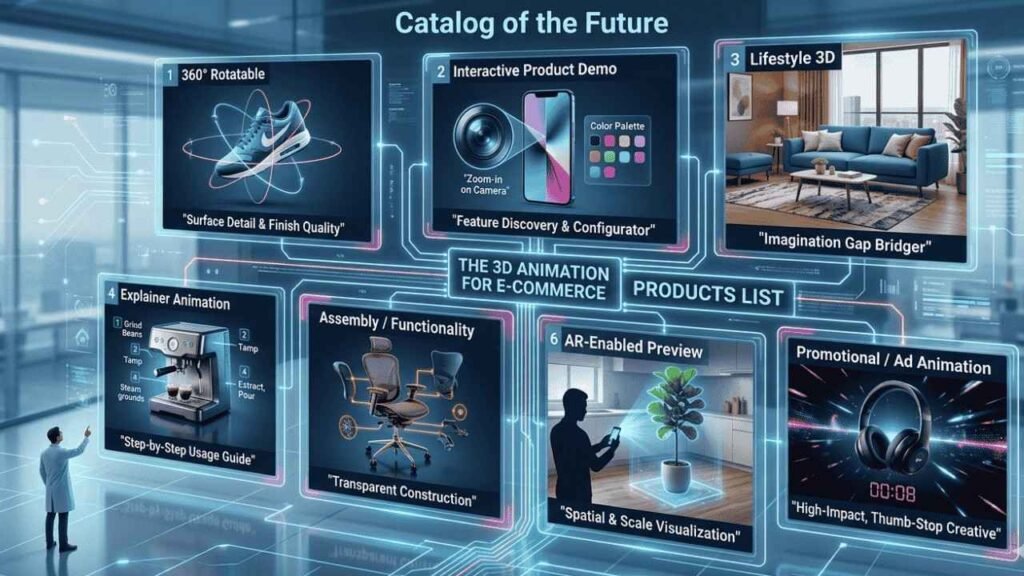
Understanding the 3D animation for e-commerce products list is essential for matching the right format to your product category, customer journey stage, and marketing channel. Each animation type serves a distinct commercial purpose:
1. 360° Rotatable Product Animation
The most widely adopted format in e-commerce, 360-degree product visualization allows shoppers to interactively orbit a product model through a full horizontal (and often vertical) axis. This format is particularly effective for products where surface detail, symmetry, or finish quality drives purchase decisions — watches, footwear, electronics, and packaging-heavy consumer goods. Shopify’s native 3D/AR support and Amazon’s 360° product viewer have made this format accessible to sellers at virtually every scale.
2. Interactive Product Demo
An interactive product demo extends beyond rotation to include zoom functionality, configurable color or material variants, and animated feature highlights. This format functions as a virtual product showcase — replicating the behavior of an in-store sales associate who demonstrates a product’s key selling points in sequence. The commercial value is highest for complex products where features are non-obvious from appearance alone.
3. Lifestyle 3D Animation
Lifestyle animations place the product within a photorealistic environmental context — a sofa in a styled living room, a coffee maker on a marble kitchen counter, a smartwatch on a wrist mid-run. This format directly addresses the imagination gap: the shopper’s inability to visualize how a product will look and feel in their own life. For furniture e-commerce and home goods, lifestyle animation consistently outperforms isolated product photography on both engagement metrics and conversion rate.
4. Explainer Animation
Explainer animations walk the viewer through a product’s usage workflow step by step — from unboxing through setup to daily use. This format is engineered to reduce post-purchase friction and pre-sale hesitation simultaneously. For electronics e-commerce, software-integrated devices, and subscription products with installation requirements, a well-executed explainer animation can materially reduce both return rates and customer support volume.
5. Assembly / Functionality Animation
Assembly animations disassemble a product into its component parts and reassemble them in sequence, giving the viewer a transparent view of how the product is constructed and how it functions internally. This format is indispensable for furniture e-commerce (flat-pack assembly visualization), power tools, automotive accessories, and any product category where assembly complexity contributes to return rates or negative reviews.
6. AR-Enabled Product Preview
Augmented reality product previews integrate a 3D product model with the shopper’s real-world environment via smartphone camera, enabling true-to-scale spatial visualization. As an AR product demo format, this technology has demonstrated some of the strongest conversion impact in the industry — particularly for furniture and home decor, where scale mismatches are among the top drivers of returns. Both Shopify AR and Amazon’s View in Your Room feature have made AR previews commercially viable for mid-market brands.
7. Promotional / Ad Animation
Short-form 3D product animations optimized for paid social (Instagram Reels, TikTok, Facebook Ads) and display advertising represent a distinct but strategically important format. Conversion-focused product animation in this context typically runs between 6 and 15 seconds, combining dramatic camera movement, material rendering, and a single clear value proposition. The format dramatically outperforms static ad creative on thumb-stop rate and click-through rate in A/B tests — a critical advantage in increasingly competitive paid social environments.
How 3D Animation Improves Conversion and Engagement
The commercial case for 3D product animation ultimately rests on its measurable impact across three dimensions: conversion rate, return rate, and brand equity.
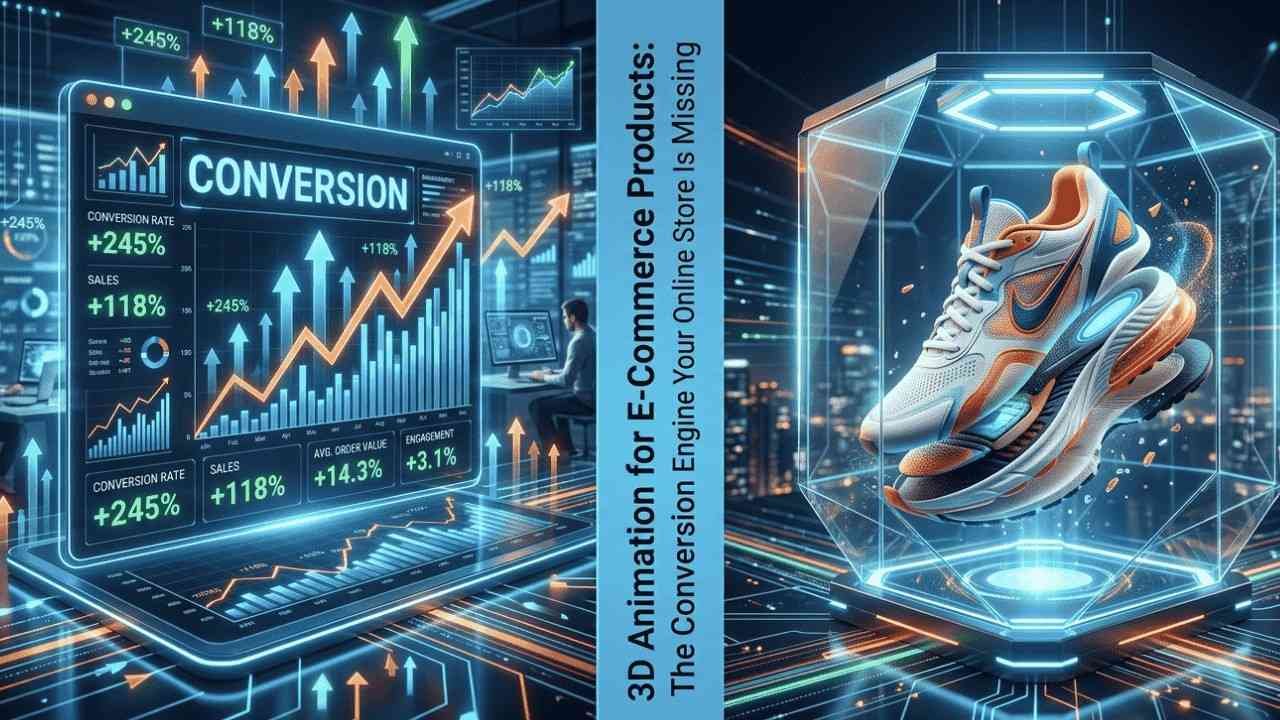
On conversion, the evidence is compelling. According to Shopify’s internal data, products with 3D/AR experiences see a 94% higher conversion rate compared to products without interactive visuals. The mechanism is well understood: interactive visualization reduces the cognitive uncertainty that triggers purchase hesitation, shortening the path from product discovery to checkout.
On returns, 3D animation addresses the root cause rather than the symptom. When a shopper can rotate, zoom, and contextually preview a product before purchase, the gap between expectation and reality narrows — and it is precisely that gap that generates returns. For categories like furniture e-commerce and fashion e-commerce, where return rates routinely exceed 30%, even a 15–20% reduction translates into a substantial improvement in net margin.
On brand equity, interactive product experiences signal investment, quality, and consumer-centricity. Brands that deploy immersive shopping experiences consistently score higher on perceived quality and purchase intent metrics compared to competitors using only static imagery — particularly among mobile-first shoppers under 35.
See how Render Edge Studio helps brands achieve higher conversion with 3D animation. Explore our Product Animation portfolio to view live examples across fashion, electronics, and furniture categories.
Integrating 3D Animation Across Platforms and Channels
Effective deployment of 3D product animation requires a platform-aware integration strategy. The same underlying 3D asset can — and should — be formatted and distributed across multiple touchpoints to maximize ROI per production dollar.
E-Commerce Platform Integration
Shopify supports GLB/USDZ file formats natively, enabling 3D product previews and AR experiences directly on product pages with no third-party app required. Amazon’s 3D product rendering program allows brand-registered sellers to upload 3D models for display in the Amazon store and AR preview. WooCommerce supports 3D/AR via plugins including Zakeke and Modelry, making product visualization for online stores accessible to independent retailers at manageable cost.
Marketing Channel Deployment
The same 3D model used on a product page can be rendered into short-form video for Instagram, TikTok, and Facebook Ads — dramatically reducing per-channel production costs. Email campaigns integrating 3D product GIFs consistently outperform static image emails on click-through rate. For brands running Google Shopping and Performance Max campaigns, 3D-rendered product imagery improves visual quality scores and ad relevance ratings.
Mobile-First Optimization
With over 60% of global e-commerce traffic originating from mobile devices, animation assets must be engineered for smartphone performance from the ground up. This means optimized polygon counts for real-time AR rendering, compressed video formats for fast load on mobile networks, and touch-responsive interaction design for 360° viewers. A digital product presentation that loads slowly or renders poorly on mobile will suppress conversion rather than lift it.
Case Study: 3D Animation in Practice
Rotatable 3D Watch Animation — Fashion E-Commerce
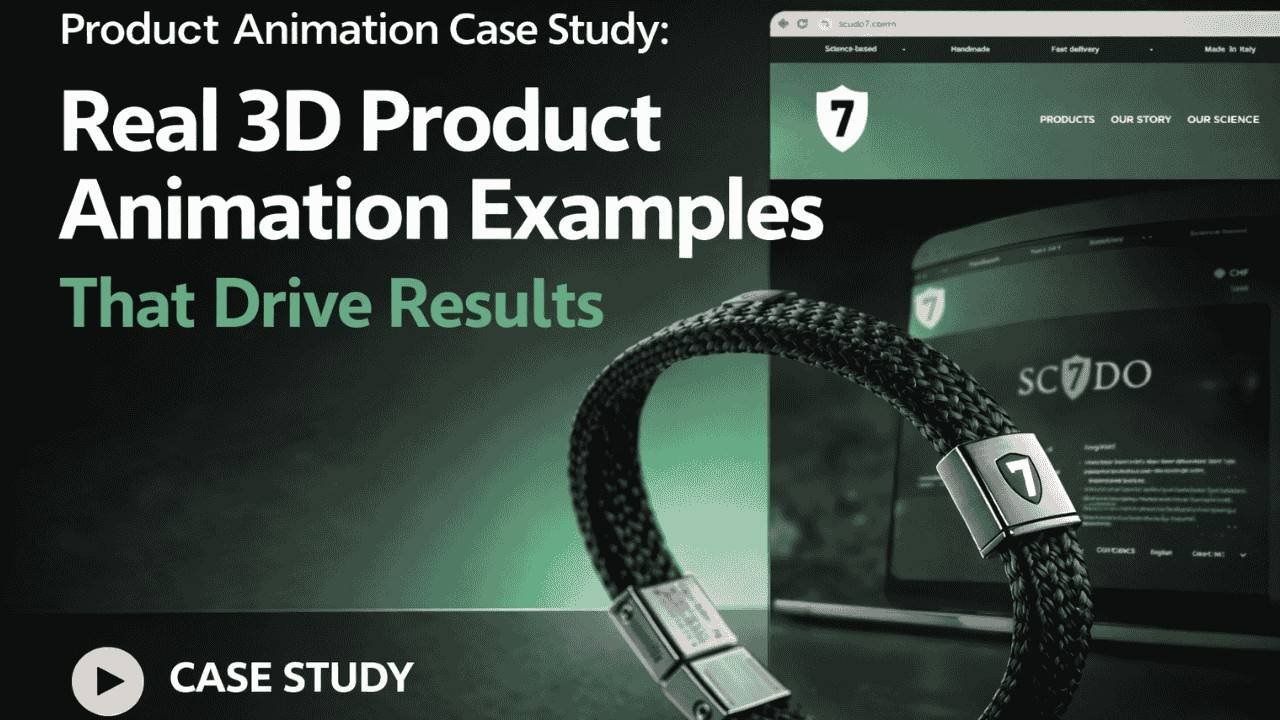
A premium watch brand operating on Shopify replaced static hero photography with a 360° rotatable 3D model across its top 10 best-selling SKUs. The 3D assets were produced to photorealistic standard, incorporating accurate material rendering of brushed steel, sapphire crystal, and leather straps. Within 90 days of deployment, the brand recorded a 20% increase in add-to-cart rate on animated product pages versus static pages, alongside a 14% reduction in return rate for the animated SKUs. The production investment was recouped within the first quarter of deployment.
Furniture AR Preview — Home Goods E-Commerce
A mid-market furniture retailer integrated Shopify AR across its sofa and dining table categories, providing mobile shoppers with true-to-scale AR product demos. The initiative was developed in partnership with Creative Animation Studios, which produced USDZ and GLB assets optimized for iOS and Android AR rendering. Post-implementation analysis showed a 35% reduction in return rates for AR-enabled products and a measurable improvement in product review scores — attributed by customers to the accuracy of pre-purchase visualization. For deeper context on similar results, see our 3D Furniture Animation case studies.
Why Choose Professional 3D Animation Services?
The quality ceiling of 3D product animation is determined by the expertise of the team producing it — and in e-commerce, where visual quality is a direct proxy for perceived product quality, the gap between amateur and professional execution is commercially significant.
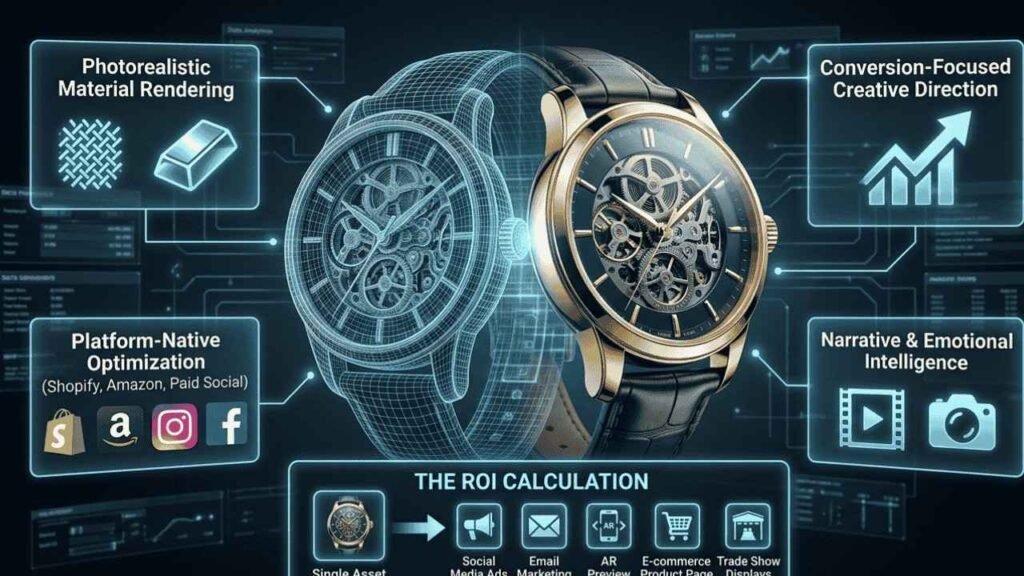
Professional studios like Render Edge Studio and Creative Animation Studios bring four critical competencies that generic production tools cannot replicate. First, photorealistic material rendering — the accurate simulation of metal, glass, fabric, and leather that makes a 3D model indistinguishable from a photograph. Second, conversion-focused creative direction — the understanding that every camera angle, animation beat, and transition should serve a commercial objective, not just an aesthetic one. Third, platform-native optimization — ensuring that assets perform at specification on Shopify, Amazon, WooCommerce, and paid social channels simultaneously. Fourth, narrative and emotional intelligence — the capacity to tell a product’s story in motion, creating the kind of brand recall that static imagery cannot generate.
The ROI calculation for professional 3D animation is straightforward: a single high-quality 3D asset, produced once, can be deployed across product pages, social ads, email, AR previews, and trade show displays — at a fraction of the cost of recurring photography sessions across those same channels.
Contact Render Edge Studio today to transform your e-commerce products into high-converting 3D experiences. Get a custom quote for your product category — fashion, electronics, or furniture.
Frequently Asked Questions
Q: What is 3D animation for e-commerce products?
A: 3D animation for e-commerce products is the use of computer-generated, photorealistic product models — animated to rotate, disassemble, or interact with environments — as a replacement or supplement for static product photography on online retail platforms.
Q: How does 3D animation increase online sales?
A: 3D animation increases online sales by reducing the primary driver of purchase hesitation: visual uncertainty. Shopify data indicates that products with 3D/AR experiences convert at rates up to 94% higher than static product pages.
Q: Which industries benefit most from product animations?
A: The highest commercial impact is documented in fashion e-commerce (jewelry, watches, apparel), electronics e-commerce (gadgets, smart devices, appliances), and furniture e-commerce (sofas, tables, chairs).
Q: Can 3D animation be used for social media and advertising campaigns?
A: Yes — and with compelling results. Short-form 3D product animations rendered for Instagram, TikTok, and Facebook Ads consistently outperform static ad creative on thumb-stop rate and click-through rate.
Q: How much does it cost to create a 3D product animation?
A: Pricing varies by product complexity, animation type, and production quality tier. Professional studios offer tiered packages aligned to e-commerce ROI objectives — contact Render Edge Studio for a category-specific quote.
Final Word
The transition from static product photography to 3D animation is not a design trend — it is a structural shift in how consumers evaluate and purchase products online. The data is unambiguous: immersive, interactive product visualization drives faster purchase decisions, reduces costly returns, builds brand trust, and delivers measurable ROI across every major e-commerce platform and marketing channel.
For brands operating on Shopify, Amazon, or WooCommerce — in categories from fashion e-commerce to electronics and furniture — the question is no longer whether to invest in 3D product animation, but how quickly to scale it and how strategically to deploy it.
Render Edge Studio specializes in conversion-focused 3D animation built for e-commerce performance. From 360-degree product visualization and AR product demos to short-form social ad animation, our team delivers assets engineered to move shoppers from browse to buy.
Partner with Render Edge Studio to boost your e-commerce sales today. Explore our Portfolio, view our 3D Furniture Animation and Amazon 3D Product Rendering work, or contact us for a custom production quote — and discover what immersive product visualization can do for your brand.