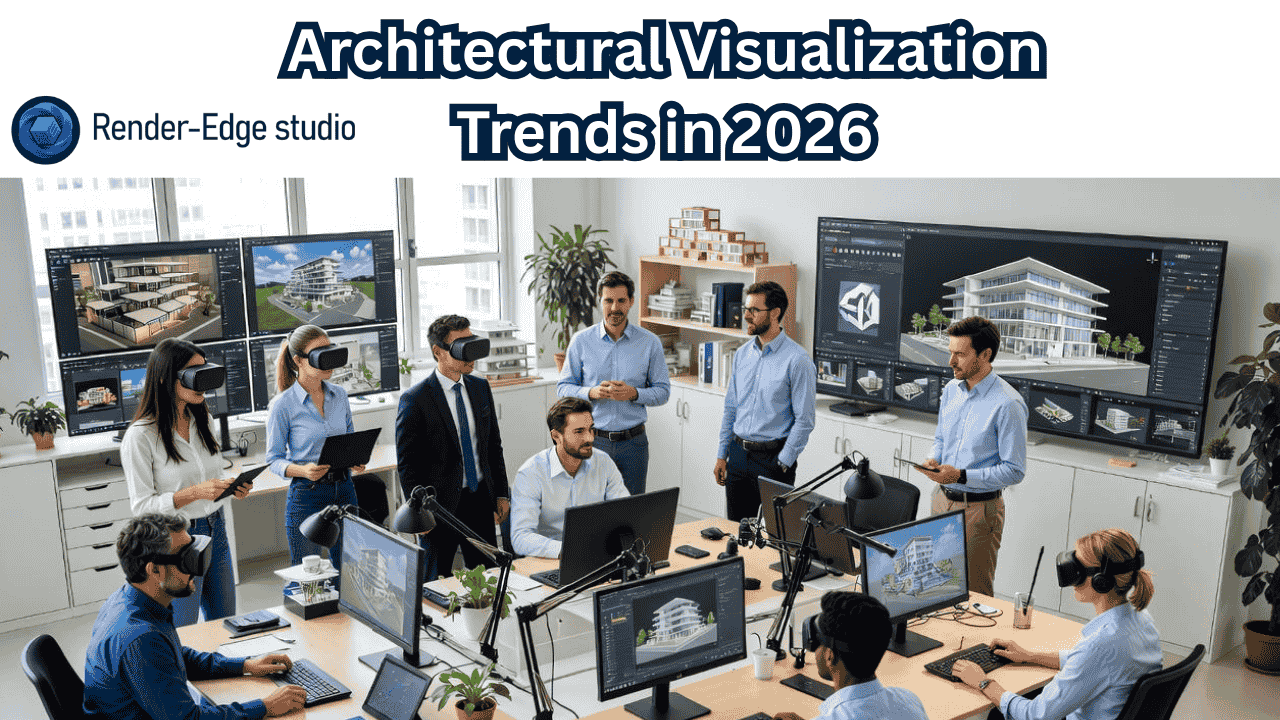
Hey, imagine you’re sitting with me over coffee and I tell you: “In 2026, the way we show unfinished buildings to clients will feel more like playing a video game than opening a PDF.”
You’d probably laugh, but that’s exactly where we’re headed.
I’ve spent the last 12 years running an architectural visualization studio, and I’ve watched the industry flip upside down more than once. Right now, we’re in the middle of the biggest leap yet. So let’s talk about the real architectural visualization trends in 2026 — the ones that will actually change your daily work, not just sound cool in a headline.
1. Real-Time Rendering Is No Longer “Nice-to-Have” — It’s the New Normal
Remember waiting 18 hours for one exterior render in 2018? Those days are gone.
By 2026, every serious architectural visualization studio uses real-time engines like Unreal Engine or Unity 3D as their main tool. Clients walk through the building, change the oak floor to walnut, and watch the afternoon light shift — all in the same meeting.
Real example: Last month we presented a 120-apartment project to a developer in Dubai. Instead of 25 static images, we gave him an Oculus Quest and 10 minutes. He approved the design (and the budget increase) on the spot. That’s the power of real-time visualization technology.
2. AI Stops Being a Toy and Starts Saving 40–60 % of Your Time
Everyone tried those “type a prompt → get a pretty picture” tools in 2023. Most looked terrible in architecture.
Fast-forward to 2026: AI-driven architecture design tools now understand Building Information Modeling (BIM) data. They can:
- Auto-populate rooms with furniture that matches your style and local fire codes
- Generate five different façade options in 3 minutes instead of 3 weeks
- Fix messy Revit geometry before you even notice it
I tested this myself with a 45,000 sq ft office project last quarter. Generative design + AI cleanup shaved 47 % off modeling time. The client never knew — they just got better options faster.
3. VR and AR Move From Show-off to Everyday Decision Tools
Picture this: You’re on site with the contractor. You lift your phone, point at an empty plot, and boom — the finished six-story building appears in Augmented Reality (AR) at real scale. You spot that the balcony blocks the sea view on floor four. You fix it before pouring one cubic meter of concrete.
That’s not sci-fi. That’s Tuesday in 2026.
High-end real estate developers use 3D architectural tools like this daily now. Immersive VR and AR in architecture cut change orders by 30–40 % (McKinsey 2025 report). Less change orders = happier clients and fatter margins.
4. Sustainability You Can See (and Sell)
Clients don’t just want to hear “this building is green.” They want to see it.
In 2026, every good visualization shows:
- How much energy the solar panels will actually produce at 3 p.m. in July
- Where natural ventilation cools the lobby without AC
- How the green roof looks in year one… and year five
We now bake live energy data straight into Unreal Engine. The client spins the model, taps the roof, and a small overlay says “This saves you $187,000 in electricity this year.” Numbers beat buzzwords every time.
5. The Death of Boring Flythroughs (Finally)
If your architectural walkthrough and flythrough still looks like a 2015 YouTube video with Ken Burns zoom, you’re toast.
2026 buyers expect:
- Camera paths they control themselves
- Day-to-night sliders
- Weather choices (yes, they want to see their house in the rain)
- People who actually look like their future neighbors
Pro tip: Check how we do “AI Transform Animation” if you want to see the new standard.
Quick Comparison: 2024 vs 2026 Workflow
| Task | 2024 (Old Way) | 2026 (New Way) | Time Saved |
| Create 5 façade options | 3–4 weeks | 4 hours | 95 % |
| Client presentation | 40 slides + 10 static renders | 10-minute VR/AR tour | 80 % |
| Change materials after review | 2–3 days re-rendering | 30 seconds in real-time | 99 % |
| Show energy performance | Separate PDF report | Live dashboard inside the model | – |
5 Mistakes You’ll Still See in 2026 (Don’t Be That Studio)
Even with all this tech, some studios will keep making the same mistakes in architectural animation:
- Treating AI like the artist instead of the assistant
- Delivering VR files that only work on a $4,000 PC
- Forgetting humans in the scenes (empty buildings feel dead)
- Using “perfect” weather 100 % of the time (nobody trusts it)
- Skipping mobile AR — half your clients view on an iPad now
Step-by-Step: How to Prepare Your Studio for 2026 Right Now
- Pick one real-time engine (I recommend Unreal Engine 5.4+ for architecture)
- Train one team member for two weeks — they’ll train everyone else
- Start every new project with a quick VR prototype on week one
- Add one AI tool to your stack (we use Veras, Krea, and Luma daily)
- Update your portfolio — delete anything older than 18 months that isn’t interactive
Do these five things in the next 90 days and you’ll be ahead of 90 % of the competition.
FAQs About Architectural Visualization Trends in 2026
Q: Will AI replace human visualization artists?
A: No. AI replaces repetitive tasks. The artist who uses AI beats the artist who fears it.
Q: Is VR worth the cost for small projects?
A: Yes — even a $10,000 house renovation sells faster when the homeowner “walks” it first.
Q: What software wins in 2026?
A: Unreal Engine + Revit/Enscape/Twinmotion bridge for most studios. Unity is still strong for mobile AR.
Q: How much faster is the future of 3D architectural rendering?
A: A typical project that took 4–6 weeks in 2023 now takes 7–10 days with the same (or better) quality.
The Bottom Line
By 2026, the studios that win won’t be the ones with the shiniest renders. They’ll be the ones who make clients feel the space before it exists.
Architectural visualization trends in 2026 are simple: make it fast, make it real, make it interactive, and make it sustainable.
If you do that, clients won’t just like your work — they’ll fall in love with buildings that aren’t built yet.
Want to see these trends in action on your next project? Drop me a message. Let’s build something amazing together.
Learn More
3D Architectural Animation: Cost, Process, Benefits, Trends & Complete Guide