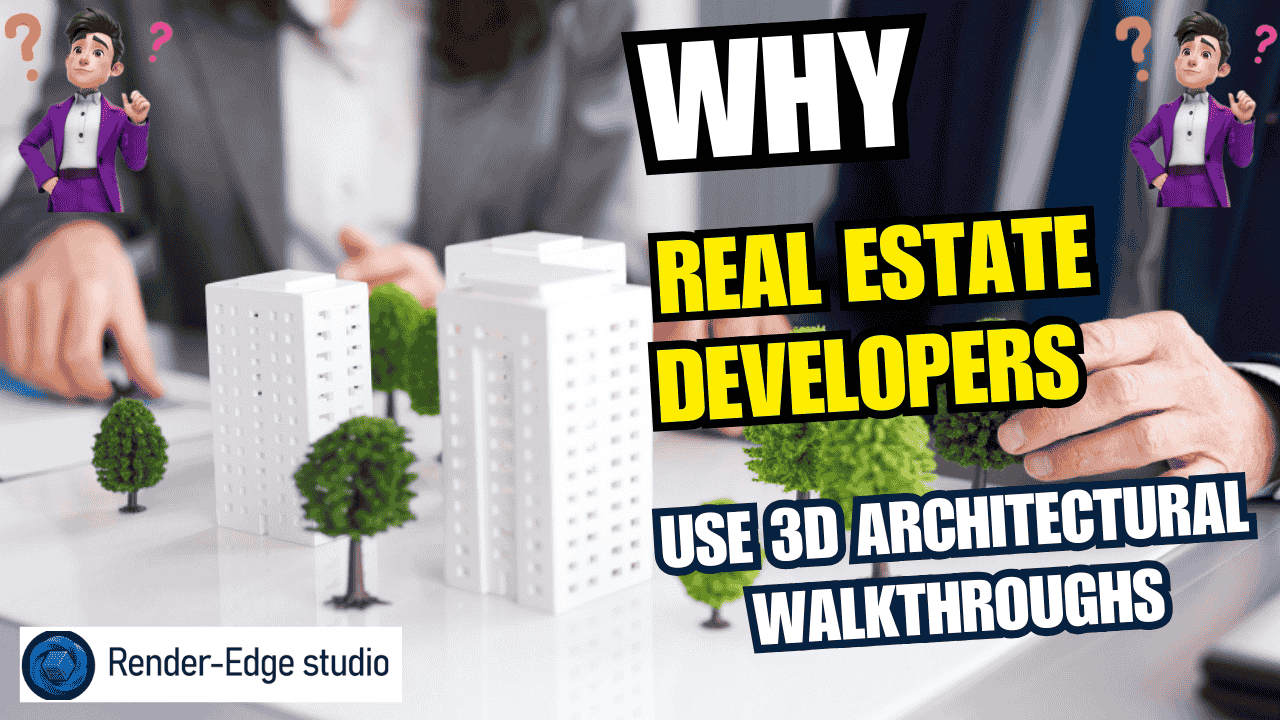
Hey, imagine this: You’re trying to sell a $50 million condo tower that’s still a hole in the ground. Your brochure has pretty pictures. Your competitors have a full cinematic tour where buyers walk through the penthouse at sunset, open the fridge, and watch the city lights flicker on.
Who do you think gets the deposit first?
That, my friend, is exactly why real estate developers all over the world are now obsessed with 3D architectural walkthroughs. Let’s break it down like we’re grabbing coffee together.
What Is 3D Architectural Walkthrough Anyway?
A 3D architectural walkthrough (sometimes called 3D walkthrough animation) is a short, movie-like video that lets anyone “walk” through a property that hasn’t been built yet.
Think of it as Google Street View on steroids — but for a building that only exists inside the computer right now.
You start at the grand entrance, glide through the lobby, take the elevator, step into the kitchen, and end on the rooftop terrace while the sun sets. All in 60–120 seconds.
Architectural Animation vs 3D Rendering: Quick Difference
People always mix these up, so here’s the simple breakdown:
| Task | 3D Rendering | Architectural Animation |
| Type | Still image | Moving video (walkthrough) |
| Time to create | 1–3 days per image | 2–6 weeks |
| Emotional impact | Nice | WOW |
| Best for | Brochures, boards | Websites, pre-sales, investors |
That’s why developers choose the moving version when they want sales to close faster. You can check out the details guide on Architectural Animation vs 3D Rendering: Key Differences.

7 Real-World Reasons Developers Can’t Live Without Them
1. Buyers fall in love before the foundation is poured
Static floor plans don’t make your heart race. A smooth camera flying through a sun-lit living room does. Emotion = faster decisions.
2. Pre-sales skyrocket (even for off-plan projects)
In Dubai, Emaar used a 3D walkthrough for Address Beach Resort and sold 70 % of units before groundbreaking. In India, Lodha, Park used one walkthrough and closed ₹400 crore in one weekend.
3. Zero travel needed for international investors
A buyer in Singapore can tour your Mumbai project at 10 p.m. with a glass of wine. No flights, no jet lag, just a link.
4. Spot (and fix) design mistakes early
One of our developer clients discovered the master bedroom felt cramped only after seeing the walkthrough. Fixed it in software → saved ₹18 lakh in change orders later. Here is the detailed guide on Architectural Animation Mistakes.
5. Marketing becomes stupidly easy
One 90-second video works on Instagram Reels, YouTube, WhatsApp, project group, sales gallery big screen, and even WhatsApp status. One asset → 100 uses.
6. You look more professional than 95 % of your competitors
When every other developer is still showing 2D colored plans, you roll up with cinematic virtual property walkthroughs. Instant credibility.
7. Higher price justification
Luxury buyers happily pay a premium when they can already “feel” the marble countertop and hear the waves from the balcony (yes, we add sound too).
How Much Does a Good 3D Architectural Animation Cost in 2025-2026?
| Project Type | Typical Price Range (USD) | Length 90–120 sec) |
| Mid-rise residential | $8,000 – $15,000 |
| Luxury villa or penthouse | $15,000 – $25,000 |
| Full township / large mixed-use | $30,000 – $70,000+ |
Yes, it sounds expensive — until you realize one extra unit sold covers the entire cost ten times over. Here is the detailed guide on the cost of 3D architectural animation.
Step-by-Step: How We Create a 3D Walkthrough That Actually Sells
- You send us floor plans, elevations, mood boards, and reference images.
- We build a rough 3D model and send you a playable preview in 7–10 days.
- You give feedback (“make the kitchen island bigger, add evening lighting”).
- We add furniture, plants, people, moving cars, water ripples, golden-hour sunlight.
- Final render in 4K + vertical version for Reels + VR version if you want.
- Delivered in under 5 weeks (rush options available).
Latest Architectural Visualization Trends Developers Are Using Right Now
- Real-time walkthroughs (buyers control the camera with mouse or phone)
- VR-ready versions for Oculus/Meta Quest
- Day-to-night automatic transition in one video
- Personalized versions (change sofa color or flooring with one click)
- Adding subtle lifestyle sounds (coffee machine, kids laughing, ocean waves)
FAQs – Everything You Wanted to Ask
Q: Can we use the same walkthrough for interior and exterior?
A: Absolutely. Most projects start outside, fly over the landscape, enter the lobby, go up the elevator, and end inside the show unit.
Q: Do 3D walkthroughs really help close sales faster?
A: Yes. Multiple studies (and our own data from 200+ projects) show decision time drops 40–60 % and conversion lifts 25–35 % on average.
Q: Is it worth it for affordable housing projects?
A: Even more. When budgets are tight, buyers need extra confidence. A good walkthrough removes doubt.
Q: What software is used for architectural visualization in 2025-2026?
A: Unreal Engine 5, Lumion, Enscape, and 3ds Max + V-Ray are still the leaders.
Final Thought
Look, blueprints and pretty renders were cool in 2018.
In 2025-2026, if you’re still selling million-dollar properties with static images, you’re bringing a knife to a gunfight. A great 3D architectural walkthrough doesn’t just show the building. It lets people move in emotionally before the first brick is laid. And when buyers are already mentally arranging their furniture…
…closing the deal becomes the easiest part of your week. Want to see how this would look for your project? Drop me a message. I’ll send you real samples and case studies (no generic portfolio spam, promise).
You’ve got the vision. Let’s give your buyers the experience they’ll never forget. Talk soon!
You Also Read